344

In this blogposting…
* The Afghan Footballer
* La vie en France / Life in France
* Argentina

He who dares…

THE AFGHAN  FOOTBALLER
I’ve received this charming and heart-warming story from Eric and Jean.  Sometimes, great and incontrovertible truths are embedded in stories such as this one.

The Liverpool manager flew to Kabul to watch a young Afghani play football.  He was suitably impressed and arranged for the player to come over.

Two weeks later Liverpool were 2 - 0 down to Chelsea with only 20 minutes left. The manager gave the young Afghani striker the nod, and on he went.

The lad was a sensation. He scored 3 goals in 20 minutes and won the game for
Liverpool.  The fans were delighted, the players and the coach were delighted and the media loved the new star.

When the player came off the pitch he phoned his mum to tell her about his first day in  English football.

'Hello mum, guess what?' he said, 'I played for 20 minutes today, we were 2 - 0 down but I scored 3!  They call it a hat-trick, and we won!

Everybody loves me, the fans, the press, they all love me!’

'Just wonderful,' says his mum, 'Let me tell you about my day …

Your father got shot in the street, your  sister and I were ambushed and assaulted, she would have been raped but for a passing police vehicle.  Your brother has joined a local gang of looters and set fire to some buildings and all the while you tell me that you were having a great time!!'

The young lad was very upset.

'What can I say mum, but I'm really sorry.'

'Sorry?!!!  Sorry?!!!' says his mum, 'It's your bloody fault we came to Liverpool in the first  place!'


**********

LA VIE EN FRANCE / LIFE IN FRANCE
MARKET DAY
One of the things I most look forward to when I visit Beaujolais - something I love doing as often as I can when I’m there - is to visit the Saturday morning market at Chatillon-sur-Chalaronne.

Traditional town and village markets are still very common in France, which goes some way to explain why the rural economy there is so lively and buoyant.  The large supermarkets do not control agriculture to nearly the same extent as they do here; small farmers are much more likely to form co-operatives and sell their produce at local markets - which can be very local indeed.

This means that the best local produce often never leaves the area of origin and people flock from miles around to obtain it.  This is especially true of Chatillon, which lies at the centre of a large area of rich and fertile farmland - and not far from Bresse, which produces the best chickens in all of France.

To give you a flavour of this wonderful market, let me take you on a tour….

You can see the ancient market hall behind me.  The stallholders at the entrance are selling ‘livestock’, mostly pets.  There are rabbits, guinea pigs, gerbils, hamsters, rats and mice.  There are pigeons, doves, ducks and geese. 

Unfortunately, it is not yet unfashionable in France to keep birds in cages so there are also budgerigars, canaries, parrots and exotic finches.  I try to ignore them while I stroke the rabbits.

There are also hens for sale.  Last year, we bought three hens here - Julia, Jean and Hildie - and two weeks ago, we bought a fourth - Carla Bruni.  In this video, she’s the brown one with the lighter-coloured tail feathers, more or less in the thick of it.

(When we got her home, Julia, Jean and Hildie gave her a very hard time indeed, plucking at her feathers and chasing her round the compound.  It was the first time I’d ever seen a demonstration of what ‘establishing a pecking order‘ means.)

Next comes the flower seller.  From hot-houses all over France come blooms of all kinds, as well as cacti and bonsai.

Over the aisle from him is the first of the market’s many producers and sellers of honey.  The French take honey very seriously and most local producers like this will offer three or four types - forest, flower, field and hedgerow - in very big jars.  They usually have honey-related goodies too - honey-cakes, beeswax polish and candles…

Next is the first of many sausage-sellers.  French saucissons are solid, weighty affairs that can attain huge, un-sausage-like proportions and are almost always flavoured with un-sausage-like ingredients, like walnuts, apples and even bilberries.

(I’m ashamed to admit that this French affection for the native European bilberry is one of the things that draws me back there again and again.  Yes - the humble bilberry!  In England, it’s been replaced in the shops by the American blueberry - big and fat and strongly flavoured.  Each time I visit France, I thank the Fates that the French still vastly prefer the more delicate, gentler, subtler and aromatic bilberry, which they call myrtille sauvage

Interestingly, this translates into English as ‘wild blueberry’.  So if you see some jam labelled thus, it’s made of bilberries, not blueberries.  These things are important to maniacs like me.)
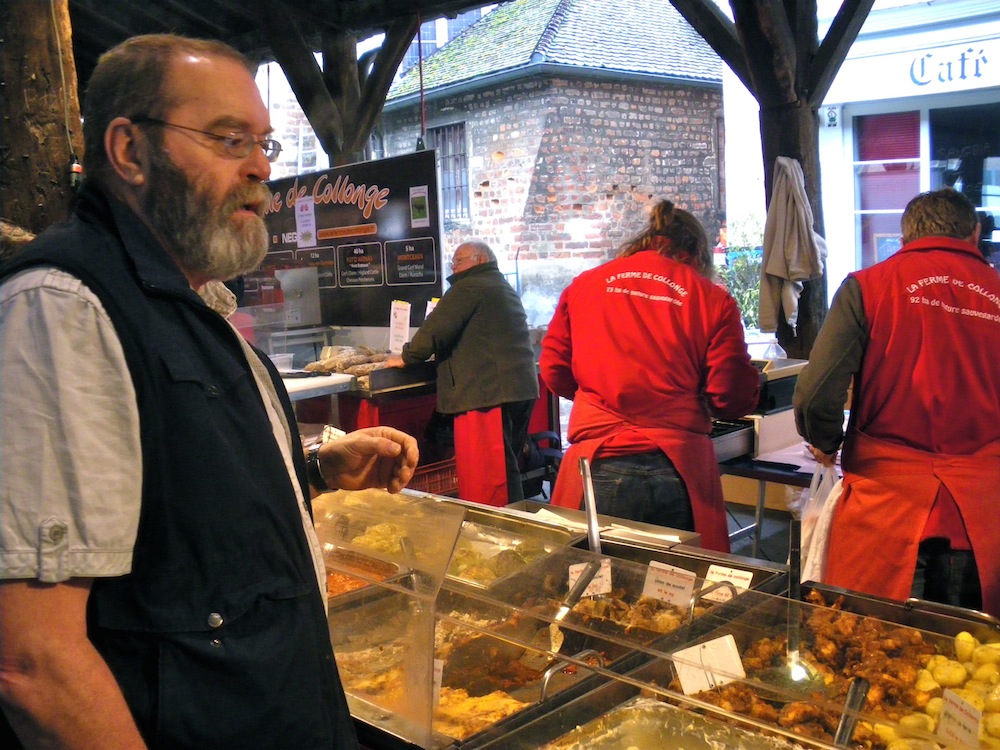
Next is our favourite stall; the farm co-operative that cooks and sells Bressane chicken - and lots more besides.  There are hot ham hocks, gammon joints, sausages, offal, mountains of sauerkraut (which is enormously popular in France: they call it choucroute).  Here also are potatoes in many forms - lightly boiled in their skins with parsley and butter, or (my absolute favourite) pommes dauphinoise with the creamiest, tastiest sauce imaginable.

We always spend far too much money at this stall.

Across the way, after the seller of sweets, bon-bons and chocolate, come purveyors of cheese.  Firstly, there are medium-sized rounds of popular local tommes - mild, soft cheeses.  There are cows’ milk cheeses from the high Alps; large rounds a foot in diameter and covered in a very thick, dark brown rind.

There are cheeses from elsewhere in France, too, as you’d expect from a country that thinks it produces the best cheese in the entire world (but doesn’t).  Raclette, Camembert, Roquefort and dozens of others.

Goats’ cheese is enormously popular (a fact of which I whole-heartedly approve) and is piled high here, too.  Small rounds of stronger, more intensely bittersweet cheese, often flavoured with nuts, seeds, herbs or fruits and almost always produced in the very fields and farms we drove past to get here.

My favourite of all though - the cheese which, all alone, almost (but not quite) justifies French cheese snobbery, is vacherin.  It’s a speciality cows’ milk cheese produced only on the slopes of the Jura mountains, especially Mont D’Or, only in fairly large rounds encased in balsawood and only available between September and May.

It’s sensational - and very expensive.  Soft, gooey and very strong; the best vacherin blows the enamel off your teeth and leaves it on the roof of your mouth.  You know when you’ve had a mouthful of vacherin.

Normally, I’m not a fan of strong cheese but I would walk, crawl, limp or (given half a chance) hitch-hike for several days to lay my hands on a round of vacherin.

Fortunately, I don’t have to.  It’s often available in Waitrose!

It’s only a shame that the French don’t return the compliment.  English cheese is unobtainable in France.  I know - I’ve tried to find some.  To the French, there’s no such thing as English cheese.

**********

In the corner of the hall are the fruit and vegetable sellers.  Here, you’ll find locally-grown salad leaves of every conceivable shape and colour.  Swedes, carrots, onions, radishes, potatoes, chard, onions, spinach, onions, parsnips (occasionally; the French aren’t sure what to do with parsnips), peas, onions, beans, tomatoes (especially big, indented beef tomatoes), onions, artichokes, fennel...

There are mountains of strawberries and oranges, lemons and plums, cherries and raspberries, bananas and limes, pears, peaches and nectarines - although I’m disappointed to report that the range and quality of dessert apples in France is uniformly awful.  Remember that this is the country that gave the world the truly disgusting Granny Smith; tasteless, ubiquitous and unrewarding - the apple equivalent of Simon Cowell or Dale Winton.

**********

Take a deep breath...

Next, there’s the oyster-man in the archway leading out into Church Square....
 
And the seller of dried flowers...
 
Next to him is the herb-stall, with trays of heavy-scented lavender, vervain, vetiver and camomile - and culinary herbs like rosemary, oregano, basil, nutmeg, mace and cinnamon.

Apart from garlic and chillis, spices are less common in France than they are here.  Indian and Asian food is still fairly exotic there, though you'll see mountains of the flavourings used in North African food - France's ex-empire.

Outside on the street is the garlic vendor.  This being rural France, I’ve seen six or seven different varieties of garlic on sale here, as well as curious small elongated onions which, I have since discovered, are known as ‘banana shallots’ in England.

Across the cobbles is the mobile creperie (3 euros apiece) and the waffle-makers caravan. 

It was whilst buying a honey-drenched waffle there last week that I overheard the only argument I am ever likely to hear about French grammatical gender.  The waffle-maker offered us un waffle - masculine.  An eavesdropping passer-by insisted - rather too vehemently, I thought - that waffles were feminine and that we should have been offered une waffle, instead.

To English ears, it’s all so much dingo’s kidneys.  How lucky we are, I thought, as the protagonists fulminated and shrugged their self-righteous shoulders, that we speak a language that abandoned grammatical gender centuries ago (only to replace it with impenetrable spelling.)

**********

Remember that this is only the provender market.  The stalls selling household goods and clothers aet themselves up on the nearby Town Square and do a roaring trade.  One of the biggest stalls is run by Olivier and Karen, who proudly display a range of over 400 kitchen-gadgets; this is France, after all.

The range is staggering.  There are snail-eating kits, champagne-cork grips, tomato-peel zesters and vegetable de-stuffers ( - don't ask)....

**********

Chatillon market is a big, bustling, brash affair.  It bristles with life; it has colour, variety and a tremendous atmosphere - all in a town not much bigger than, say, Barnard Castle.  I've become hopelessly addicted to it.

And sometimes, I think how unsurprised I would be to discover that there’s a stall there selling dingo’s kidneys….

**********

THE WORLD - A TRUCKSHUNTER GEOGRAPHY
Don’t forget that our next port-of-call is Argentina.  If you have some unlikely but true lowdown on that troublesome nation - the sort of information we could blackmail it with - send it to me in the usual way.

**********

CONTACT ME
Post comments on this blog or email me:  truckshunters@googlemail.com
343
In this blogposting...
* Woodchip Sculptures
* Val
* Costa Concordia
* Gorillas
Don't just sit there...


WOODCHIP SCULPTURES
The pictures on this posting are of the amazing work of a Russian man called Sergei Bobkov, who has developed his own unique way of creating stunningly lifelike sculptures out of Siberian wood-chips (of all things).

First of all, he studies the anatomy and habits of the animal he’s going to sculpt.

Then he puts the wood-chips - which are mostly cedar and pine but can sometimes be willow or beech - into water for a few days.  Then carefully - very carefully - he rolls the chips out to form feathers or fur.  A single sculpture can take six months to make - and that’s only if he works all day, every day.

This means that, although he’s been creating these astonishing works of art for several years, there are still only 11 of them.

And none of them are for sale.  Sergei has been offered £10,000 for one but has said his works will never be for sale.

Aren’t they lovely?

********************

VAL
I’ve had a fulsome and elegant apology from Val about her non-appearance at the last AGM, and about how disappointed she was.  I think it’s worth quoting most of it verbatim because it opens a small but interesting window into the life of yer average truckshunter.

‘When I saw that the next AGM was on a Thursday, I thought that at last I'd be able to go - since last year I don't work on Thursdays.

However, I've an appointment this Thursday which I might've been able to rearrange to last Thursday. But being the only one at work with a sewing machine, my day off last week was spent making a surprise outfit for a friend at her retirement party next week. Apparently she's always wanted to wear a tutu!

I'm so disappointed not to be able to go - and another really interesting venue!  I've never been to Newcastle Arts Centre so look forward to reading your report.

Oh I just remembered, I was looking at Argos’ website earlier and noticed their 'Reproductive' Telephone Table. Would that be ‘Buy One Get one Free’ then?

I'm sure you'll have a great time on Thursday, please pass on my apologies and I'll do my best to join you all someday.’


Thanks for being so comprehensively apologetic, Val.  As you’ll know by now, the Newcastle Art Centre will have to wait for another AGM - it was closed!  So - tutus permitting - you may still be able to join us when we venture through their front door for a second attempt.

(Incidentally - what did your friend think of her tutu?  Any pictures?)

And I really liked the item from the Argos catalogue….

********************

COSTA CONCORDIA
Those of a nervous disposition may want to skip this bit.

Dave Shannon - for it is he - has sent me some jokes about the recent Costa Concordia disaster.  They are politically incorrect and in the most appalling bad taste - good enough reasons, as far as I am concerned, for me to pass them on to you.

How do they serve alcoholic drinks on Italian cruise ships?
On the rocks

What vegetables do you get with dinner on Italian cruise ships?
Leeks

What's the fastest way to get off an Italian cruise ship?
Follow the captain

When the captain of the ill fated
Costa Concordia was asked if he knew where he was going he replied ‘off course’.

So the captain of the
Costa Concordia will soon be in the dock - which is more than can be said for his ship.

The captain says he is not guilty of manslaughter. He has witnesses to prove he was nowhere near the passengers who died.

The
Costa Concordia is probably the most expensive thing to go down in Italy since Berlusconi's last hooker.

I’m particularly sorry about that last one.

********************

GORILLAS
Almost as if to make amends, Dave has also sent me a link to one of the gentlest videos I’ve seen so far this year.  It’s almost as touching as David Attenborough’s scene with the Ugandan gorillas in Life on Earth.

Those of a nervous disposition can look back now.

Just click the link below or cut-and-paste it into your web browser.  You’ll love it.

http://ourlighterside.com/2011/12/27/touched-by-a-wild-mountain-gorilla/

As you watch the video, bear in mind that - as Dave points out - there are only about 720 mountain gorillas left in the wild.  Guess which other creature is responsible for their catastrophic decline in numbers...

********************

CONTACT ME
Post comments on this blog or email me:  truckshunters@googlemail.com
342
The man responsible for Wednesday
In this blogposting...
* Pancake Day
* Feedback
* Leap Year and all that
* Hildie’s Joke
* The Legs of Lyon
* Argentina
Go on - I dare you...

PANCAKE DAY
Did you celebrate Pancake Day?  How many did you get through?
(However often I visit France, I just can’t bring myself to call them crepes.)

I have to make an unpatriotic admission here.  Much though I love English pancakes, I very much prefer the 'Scotch' variety - ‘drop scones’.  My goodness.  So delicious that they ought to be illegal.  I managed 7.
 
My preferred option
FEEDBACK
(on the Comments box of posting 341)
VIV
That really is one of the most extraordinary trails of bad luck I’ve ever heard.  I’m afraid it’s perfectly obvious that there’s either something you’re not doing or something you’re doing wrong - although I can’t imagine what this can be.  You aren’t a member of some ungodly cult, are you?  Have you broken several mirrors recently?

I would take Sid’s advice, if I were you.  Make it your business to touch a lot of wood in the very near future.

SID
I’m so glad I’m not the only one sentimental enough to maintain the magpie traditions of my youth.  Although it does mean, as you say, that we spend an unconscionable amount of time asking after the wellbeing of birds who couldn’t care less about ours (touch wood).

And I suppose - in a generous light - the superstition about bees could be seen as an early recognition of something we now know to be true:  that they are much cleverer than we might tend to give them credit for.

But....why is no-one prepared to come forward and admit to the collar-touching tradition of my younger, more innocent days?  Or did it only happen in Peterlee?  Surely not...

-------------------------------------

LEAP YEAR
So frustratingly, though predictably, inexact is the Earth’s wayward orbit around the Sun that, every four years, the naked apes that swarm over its surface must needs add an extra day to ‘make up the numbers’.  If we didn’t do this, we would eventually end up celebrating Christmas in high summer (as the benighted folk of Australia already have to) and stripping down to our bikinis in mid-November.

Making every fourth year a day longer doesn’t quite do the trick either, of course.  This is because each ‘lunisolar’ year is slightly less than 365.25 days long and adding a day every four years would thus cause our distant descendants no end of inconvenience and confusion.

Which is why, if a year is divisible by 100, it isn’t a Leap Year unless it’s divisible by 400.  1900 wasn’t a Leap Year; 2000 was.

Even this isn’t precise.  Someone whose job I want has worked out that, in 8,000 years, the calendar will still be one day out of kilter.

Researching this bit of esoterica sent me up many pleasurable, calendar-related, cul-de-sacs.  Why, for example (I found myself asking), are days so unevenly distributed amongst the months of our Roman calendar?  Why are there so many months luxuriating with 31 days while poor, weak, palsy-stricken February has to make do with (usually) just 28?

As with so many aspects of civilisation (including, incredibly, the distance between the lines on almost all the world’s railways), the blame can be laid squarely at the door of the aforementioned Romans.

The Roman year began, sensibly, on March 1 and the months ran predictably and alternately with 31 then 30 days, which left lowly February - the last month of the Roman year - with 29 days (or 30 in a Leap Year).  The months from March still follow this pattern as far as July.

The Emperor Augustus changed all that though.  July had been named after Julius Caesar and Augustus wanted the following month - in the height of summer - named after him and to have 31 days, like July has.

Being disinclined to argue the point, the Emperor’s calendar-wallahs immediately changed everyone’s lives forever by adding an extra day to August and taking one off February.

That one man had the ultimate ego-massaging power to alter the calendar is incredible enough; that we still conform to his vainglorious edicts, even more so.

-------------------------------------

My tireless and selfless researches on this subject also unearthed this excellent titbit on Wikipedia...

La Bougie du Sapeur, first published in 1980, is a humorous French newspaper published every February 29 - that is, once every four years.  Its next edition will be on February 29, 2012.  There have been eight editions of this newspaper to date.

The newspaper's name (literally, ‘The Candle of the Sapper’) is derived from a comics character, the sapper Camember, created by Georges Colomb in the 1890s.  In the story, Camember was born on February 29; so, when recruited into the army, he was 'just five years old'...

The paper was founded by Jacques Debuisson and Christian Bailly. Its editor in chief is Jean d'Indy. Each edition is printed in 200,000 copies.

In 2004, the seventh edition was accompanied by a Sunday special designed to be published on every February 29 that falls on a Sunday - once every 28 years. The next edition of the Sunday special is scheduled to be published on Sunday, February 29, 2032.

Profits of the 2008 edition went to a charity devoted to autism.

It is possible to subscribe to this newspaper, 100 euros for an entire century.


How wonderful is that!

I will be in France on this upcoming Leap Day and will do everything in my limited power to obtain a copy of La Bougie du Sapeur on all our behalves.

--------------------------------------------

HILDIE’S JOKE:  MURDER AT TESCO
Hildie sent me this recently - and I for one don’t blame her for wanting to be rid of it.

Tired of constantly being broke and stuck in an unhappy marriage, a young husband
decided to solve both problems by taking out a large insurance policy on his wife with himself as the beneficiary, and then arranging to have her killed.

A 'friend of a friend' put him in touch with a nefarious dark-side underworld figure who went by the name of 'Artie.'

Artie then explained to the husband that his going price for snuffing out a spouse was £5,000.

The husband said he was willing to pay that amount, but that he wouldn't have any cash on hand until he could collect his wife's insurance money.

Artie insisted on being paid at least something upfront, so the man opened his wallet, displaying the single £1 coin that rested inside.  Artie sighed, rolled his eyes, & reluctantly agreed to accept the £1 as down payment for the dirty deed.

A few days later, Artie followed the man's wife to the local Tesco Superstore. There, he surprised her in the produce department and proceeded to strangle her with his gloved hands.  And the poor unsuspecting woman drew her last breath and slumped to the floor........

The manager of the produce department stumbled unexpectedly onto the murder scene. Unwilling to leave any living witnesses behind, Artie had no choice but to strangle the produce manager as well.

However, unknown to Artie, the entire proceedings were captured by the hidden security cameras and observed by the store's security guard, who immediately called the police. Artie was caught and arrested before he could even leave the store.

Under intense questioning at the police station, Artie revealed the whole sordid plan, including his unusual financial arrangements with the hapless husband, who was also quickly arrested. 

The next day in the newspaper, the headline declared .... 

(You're going to hate me for this .... )

'ARTIE CHOKES 2 FOR £1.00 AT TESCO!' 


--------------------------------------------

THE LEGS OF LYON
Modern sculpture is often rightly criticised for being needlessly inexplicable.  This one, though, needs no explanation.  It stands proudly outside the Opera House in Lyon.
 
I love it.

-------------------------------------------

THE WORLD:  ARGENTINA
The next port-of-call on our worldwide geographical tour-de-force will be Argentina - the only country on Earth that’s been told not to cry.  As usual, I’ll be very grateful for any offbeat and unexpected information you can find or already know.  What do they eat there?  How do they insult each other?  What’s at Number One?  What are they really good at?

Send me an email....

-----------------------------------------

CONTACT ME
Post comments on this blog or email me:  truckshunters@googlemail.com
341
Unlucky indoors - but why?
In this blogposting…
* Things You Didn’t Know You Didn’t Know
* Warnings in Arabic
* Mister Magpie
Read and inwardly digest…


THINGS YOU DIDN’T KNOW YOU DIDN’T KNOW - FRENCH STYLE
Travellers on France’s TGVs are given a free magazine to while away the few short hours of their journeys.  With inspiration bordering on pure Gallic genius, the magazine is called TGV Magazine and is about as boring as these things almost always are - full of adverts for fitted kitchens and memory-foam mattresses or cod interviews with obscure, third-rate actors or authors.

The only thing that held my attention in this month’s dreary edition was a page of Did You Knows.  We would have called it This Month In Figures; they called it Les insolites du mois en chiffres - and it gives an interesting insight into the kind of things that French magazine producers think will fascinate their readers.  Thus….

* 2.5km - the distance travelled by bike by every Danish person every day…
* 125 - the number of portions of beef eaten in the world every second…
* 5,126 euros - the price of a lump of turf sold at auction by a Bosnian supporter after a football match between Bosnia Herzegovina and Portugal…
* 20 tonnes - the weight of a boulder (below) deposited by the Mayor of Quebec outside the home of his ex-wife after an acrimonious divorce…

* 13.6C - the average temperature in France last year…
* 210 million - the number of cinema tickets sold in France last year…
* 2.5 kilos - the amount of Brazilian cocaine found by police at Rome airport hidden in the prosthetic breasts and buttocks of a 23-year old model…
* 10 years - the prison sentence handed down to a Californian man for sexually abusing a chihuahua dog…

So now you know what engrosses French travellers as they hurtle through the countryside at 180mph.

***
WARNINGS IN ARABIC
This frankly unbelievable picture and back-story were emailed to me recently.  Worth it for the joke, though…

A new fuel tanker arrives on location somewhere in the Middle East. . . . . .

The Health and Safety manager tells the fleet supervisor to ensure that the tanker is clearly labelled Diesel Fuel and No Smoking in Arabic.

This is what he got…………………..


***
MISTER MAGPIE
I surprised myself the other day by saying Good Morning to a magpie.  It flapped across the garden and I found myself greeting it deferentially and respectfully, which is what you’re supposed to do with magpies.  And seeing a solitary magpie is, of course, the most appalling bad luck, which can only be neutralised by being very nice indeed to the magpie in question.

The custom is more widespread than I thought and its intensity varies, too.  A friend who was with me at the time, and who comes from Buckinghamshire, berated me for not being deferential enough.  Where he comes from, you have to say ‘Good morning, Mr Magpie - how’s the wife and kids?’

Folklorists have suggested that the ill-omens attached to solitary magpies exist because they mate for life; thus, to see a lone magpie is a sign of sorrow and ill-fortune.  This also goes some way to explaining the first line of the magpie nursery-rhyme - you know the one…

One for sorrow, two for joy, three for a girl, four for a boy, five for silver, six for gold, seven for a secret never to be told…

As far as I know, though, no-one who interests themselves in such things has come up with an explanation for three, four, five, six or seven.

A Blue Bus listener once called with a continuation of the rhyme up to ten, but I’ve forgotten what she said.  If you were paying more attention than me and know the chant beyond seven, please get in touch.

In other cultures, far and wide, the magpie’s reputation is as a thief.  Indeed, Rossini wrote an opera with that very title:  La gazza ladra - The Thieving Magpie.  I reckon it’s about time this unfortunate bird was rehabilitated.  I’ve always quite liked them.  It’s just a shame that, locally, everyone thinks you’re talking about a football team.  That really is bad luck.

***

It’s not just magpies, of course.  Many other creatures make their way through the world unknowingly bearing the burden of human superstition - humans being what they are.

From my own misspent youth I can remember the awful significance attached to cats.  Except that my memories seem to be at odds with everyone else’s.  In my great scheme of things, black cats were good luck and white cats, bad.  Most people’s recollections put them the other way round.

Not that I had much of a chance of testing the superstition; I can’t recall ever knowing anyone who actually owned a cat when I was young.  People just didn’t have them.

Bees - like magpies - also had to be treated with respect.  Many folk kept a hive and, when a beekeeper died, it was absolutely essential to formally tell the bees of his death. If you didn’t, they would abandon the hive forever.

My Nana could remember visiting a house where someone had just died and being told that his wife was out ‘telling the bees’.

***

How superstitions arise and persist, in all the various forms they take worldwide, is a subject worthy of a university degree.  At truckshunter level, though, I’m just happy that they do.

In fact, I’m now racking my brains to think of as many as I can from my misspent - and ill-informed - youth.

Was it hawthorn blossom that should never be brought into the house?

Was it rowan (below) that was effective against ill-will or the ‘evil eye’?

Was it lilies that should never be given in a bouquet?

Ah yes.  They’re flooding back now.

Never cross your knife and fork on the plate.

Always get out of bed onto your right foot.

If you spill salt, pick it up and throw it over your left shoulder.

Never put shoes on the table, and remember that new shoes always creak until they are paid for.

The question that arises with all these wayward beliefs is - why?  What is (or was) it about hawthorn that made it so unlucky indoors?  Why the no-shoes-on-the-table rule?

The superstition that strikes me as the most mysterious and inexplicable of all, though, is collar-touching.

If a funeral passed by, it was necessary to touch your collar.  In fact, you had to hold your collar between thumb and forefinger until you saw a four-legged animal.  What would happen to you if you didn’t wasn’t even worth contemplating.

Looking at it now, with all the supercilious wisdom and cynicism of maturity, I find the bizarre complexity of this superstition utterly unfathomable.  I can think of no folkloric explanation for it and the few people I’ve mentioned it to tend to look at me with a mixture of sympathy and fear.

But I know I’m not imagining it because I still do it.  No funeral cortege glides past me without my holding onto my collar as if my life depended on it (which it may well do, for all I know) and scanning the street for a dog or a cat.

So, if I’m touching my collar when you see me, just point me in the direction of a four-legged animal as quickly as you can.

***

Writing this blog about childish beliefs and superstitions has given me a great deal of pleasure - of the ‘glowing, warm memories’ kind.  If you can think of any superstitions I haven’t mentioned - and there must be dozens - please get in touch.

CONTACT ME
Post comments on this blog or email me:  truckshunters@googlemail.com
340
Our carers were sitting at a different table
In this blogposting…
* AGM XXXI
* La vie en France
* Hildie’s One-Liners
Proceed at your own risk…


AGM XXXI
Sometimes, things go wrong.  There’s no power on Earth that seems able to prevent this phenomenon; nether you nor anyone else can stop it.  You may lock your keys inside the house or not remember the name of your closest friend or run over the cat.  Things like this happen - they just do.

And they did last Thursday.  Having carefully selected an exciting new venue for our 31st AGM - artistic, aesthetic, cultural, uplifting and amusing - we arrived to find it shut.

At least, the ‘business-end’ of it was.  Although its craft- and card-shop was open, the Newcastle Art Centre had decided - entirely without consulting us - to close its cafe for ‘essential renovation’.  You may be assured that I have written to the highest authority in the land about this and am expecting the appropriate reply at any time.

This did not, of course, help us as we stood shivering in the street so we decided, in typically assertive, truckshunter, style to adopt a hastily concocted Plan B - namely, to repair to the nearby Milecastle pub, there to drown our sorrow and disappointment in inexpensive but delicious coffee.
The four horsepeople of the apocalypse
‘We’, on this occasion, was Hildie, Vivienne (whose birthday it is on February 22), Neville, Ellie (who, incredibly, has just turned 69) and me.

I have to say that the last-minute change of venue did not succeed in dampening our spirits one iota - not one jot or tittle.  For over two hours we were engaged in catch-up chat, anecdote and conversation which meandered through a worryingly large - and occasionally almost surreal - range of topics.
Ripe for a saucy caption, methinks...

It was good to see everyone again, but especially Ellie, who isn’t able to attend AGMs very often and who actually mislaid Grainger Market last time round.

As usual, the photos are courtesy of the wonderful Vivienne, who thinks that we should hold a future AGM at Gibside.  And I agree; we should.

LA VIE EN FRANCE / LIFE IN FRANCE
L’AGE DE GLACE / ICE AGE
I’ve just come back from a few days in Beaujolais.  While I was there, I took genuine delight in shivering theatrically and saying how much colder it was there than it was in England.  After two years, the habitual French smugness about how cold and wet England is begins to grate a little, which is why I smiled broadly as I watched them not coping very well with frost as deep as snow and Siberian winds icy-cold enough to freeze the balls off a brass monkey ( - a phrase which I attempted to translate without any success at all - Le vent Siberien est souvent froid pour gele les boules d’un sange de cuivres).

As a matter of fact, by that time the month-long freeze was getting beyond mere inconvenience in Beaujolais.  It hadn’t got above zero for almost four weeks and Pépère told me how desperately worried the local wine-growers were.  The usual limit for vine survival is about ten days of freezing weather, so this year’s vintage may well be a poor one. 

If this happens, the local economy will suffer very badly indeed; most of the vignobles are co-operatives so everyone sinks in the same boat, which is enough to wipe the grin off any gloating Englishmen’s face.

I was grinning very widely indeed, though, as we made a winter trip west into the sparkling, ice-clear hills.  I know I’ve mentioned the comfortable beauty of the local countryside several times before; I never tire of it.  The low foothills, draped with vines and orchards, fold and heave and encourage the road to venture ever higher to the west and north - to the highest point in Beaujolais:  Mont St Rigaud, a pyramid peak which, at more than 1,010 m (3,300ft), is slightly higher than England’s highest mountain.

Our attempt to reach the summit was ‘hampered’ - to say the least - by snow-drifts.  At one point, our normally trusty Renault 407 threw all caution to the icy winds and performed a balletic skid 50ft down an ice- and snow-covered farm track and ended up facing in entirely the wrong direction.  We took this as a hint and continued our descent.  The peak will have to wait for finer, and less alarming, weather.

Beyond Mont St Rigaud - to the west - Beaujolais changes dramatically.
Beaujolais Vert from Mont St Rigaud - in better weather

Imagine the region as an upturned oval shape, like an upended rugby ball.  Draw a line down the middle.  To the right - the east - is the Beaujolais of wine (and other crops) that leads to the lush watermeadows of the Saône.  To the left is Beaujolais Vert, where the mountains are more rugged and the vines are generally replaced by deep, dark and endless forest.

This was my first trip through these remoter parts of the region and it was magical.  Tiny villages that almost didn’t exist and with mellifluous names that rolled off the tongue like snowflakes. Pépère took pictures of some of them for me….

French place-names are one of the recurring pleasures I enjoy each time I visit.  Naturally, I have my favourites - those that are hypnotically easy on the ear and tongue.  Aix-la-Chapelle, Lac d’Annecy, Thonons-les-Bains, Perouges…

And closer to home there’s Chatillon-sur-Chalaronne (where we often visit the mediaeval market), Romanèche-Thorins (which has one of the finest wine museums in all of France) and - my all-time favourite - St Symphorien d’Ancelles, which has nothing but its name.  St Symphorien d’Ancelles.  Lovely.

------------------------------------

The more observant - and perhaps better-read - amongst you may have noticed, amongst the jumble of names in the collage above, the name of Clochemerle.  A couple of weeks ago, I accidentally discovered that the lovely hillside village of Vaux-en-Beaujolais was used as the setting for one of France's best-known and internationally most poplular comic stories.

Clochemerle was written in 1934 by Gabriel Chevallier and deals with the farcical consequences of the pompous mayor's plans to install a new urinal in the village square.

All I know about the story is its name - I can recall it's being a BBC tv serial many decades ago.  Well, I've now visited the village that inspired it and I've bought the book itself (in English) so that I can immerse myself in one man's crazy view of Beaujolais village life.

If you've read it - or can recall the tv series - please get in touch.

--------------------------------------

Unimaginable cold notwithstanding, I felt compelled to make my annual pilgrimage to Montparnasse Cemetery in Paris on the way home in order to pay my respects to Saint-Saëns.  So who am I to be sarky about French weirdness when there is something vaguely but unmistakably insane about an ageing Englishman listening to The Carnival of the Animals on his headphones in a deserted and freezing inner-city cemetery?

----------------------------------

Things are improving in Beaujolais now, at last.  I’ll be returning next week for a few days and - fingers crossed - I won’t need to take my fingerless mitts, my longjohns or my Country Diary of an Edwardian Lady hot-water bottle.

---------------------------------------

HILDIE’S ONE-LINERS
Hildie recently emailed these one-liners to me.  Prepare yourselves…

A book just fell on my head.
I've only got my shelf to blame.

A man hit me with a pint of milk and a block of cheese.
How dairy!?

I'm giving up my job as a deep-sea diver.
Too much pressure.

I found a load of plasticine on my driveway.
I don't know what to make of it.


---------------------------------------------

CONTACT ME
Post comments on this blog or email me:  truckshunters@googlemail.com